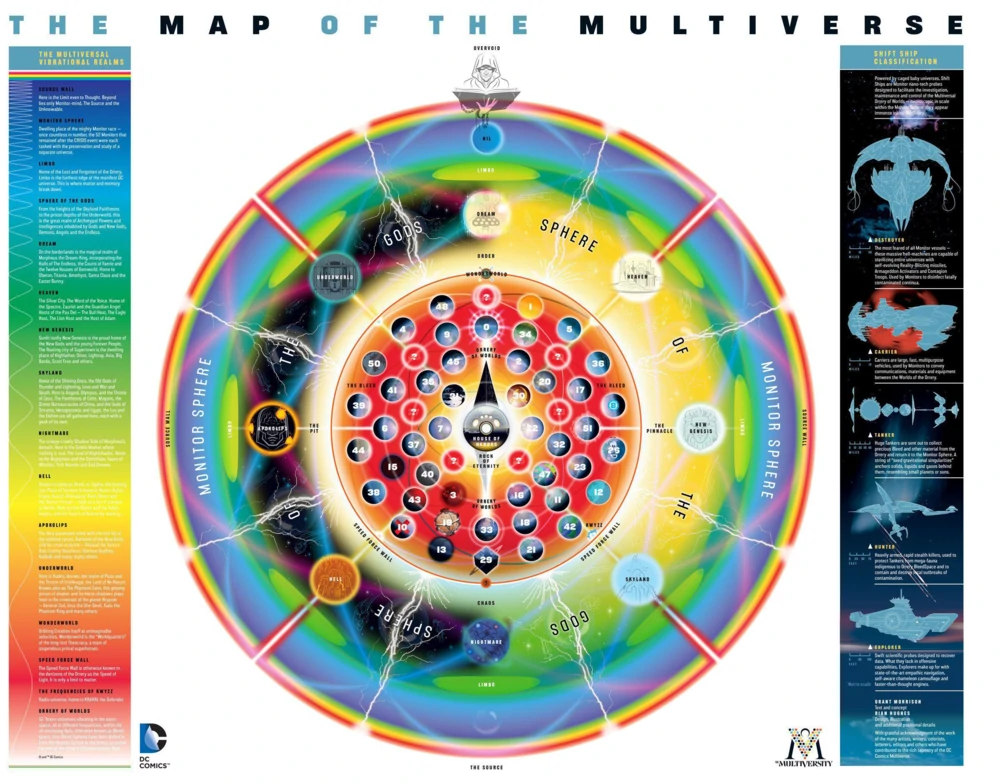
=
An ICONO-OPERON
A 7D Constraint-Governed Operadic Higher-Category Entity
oV –
4-Manifold-Generating Observers
Graphic Novels/Comics are a dual-channel perception medium where syntactic structure (panel geometry, sequencing, spatial composition) and semantic content (dialogue, narration, symbolic meaning) operate simultaneously but asynchronously (ie. “not existing or happening at the same time). They do not qualify as prose literature (linear semantic flow) nor cinema (continuous audiovisual flow). They are a discrete, self-paced recursion medium where the observer co-constructs motion, pacing, and internal continuity.
Comics induce a voluntary Ψ-rim interpolation. Or in other words – the observer supplies the connective semantic (word meanings and relations in conjunction with the cognitive structure of meaning) tissue between syntactic (structural) frames. No other medium requires a similar level of operator-generated motion.
Panel size, shape, gutters, symmetry, and mirroring are not just stylistic – they are structural. A shift in panel geometry effectively changes the emotional tone, the narrative momentum, the cognitive load, and the semantic expectation. As a Recursive Mirror Medium, Graphic Novels/Comics can collapse time, metaphor, symbolism and literal narrative into a single page spread. In cinema, metaphor is sequential. In literature, metaphor is linguistic. In the comics, metaphor is spatial and simultaneous.
Comics, therefore, allow non-linear semantic stacking in a fixed visual manifold. This makes them the closest medium to an active cognitive map. And despite them being influenced by the conventions of Literature (e.g. internal monologue, mythic structuring, symbolic recurrence, etc.) and Cinema (via shot composition, pacing, staging, lighting, implied “camera” movement, etc.), the literary devices are converted to visual rhythms and comics absorb cinematic syntax, but do not inherit its temporal demands.
Simultaneously, Graphic Novels/Comics influence both other mediums through introducing kinetic metaphors, visual-syntactic pacing (such as in Ellis-style staccato writing), storyboard logic, splash-page cinematography, and more. Cinema often imitates comic geometry, but not the other way around.
Comics affect the Observer through engaging three simultaneous channels: linguistic decoding, visual decoding, and interpanel inference (ie. gaps are filled in with the Reader’s imagined meaning). This makes them more participatory than Cinema, more guided than Literature, and more recursive than either one. Thus comics create a hybrid cognition loop – not passive absorption. The Observer co-constructs the reality of the text. This is why emotional and symbolically charged texts hit harder (e.g., Snyder’s DOTF or The Black Mirror).
You can think of it like this:
- Literature – Semantic Continuum (linear semantic flow)
- Cinema – Kinetic Continuum (continuous sensory flow)
- Graphic Novels/Comics – Discontinuous Syntactic-Semantic Field (discrete syntactic geometry and semantic interpolation (ie. “the insertion of something of a different nature into something else”))
Additionally, Comics sit exactly at the intersection of Ψ-rim (the coherence rim) structure and semantic drift. Their gaps are mini coherence boundaries in which the Observer crosses constantly. This generates micro-coherence Events. This is the exact reason comics are uniquely potent for symbolic, mythic, and psychological content.
The Discontinuous Syntactic-Semantic Medium
Thus Graphic Novels/Comics constitute a third primary media manifold distinct from Literature and Cinema. They operate specifically upon a constraint field where syntactic geometry and semantic content co-generate narrative meaning. And there are three Foundational Laws upon which the medium is built:
- Discontinuous Continuity
- Panels are discrete syntactic Events; movement occurs only when the observer crosses the gutter. A coherence micro-boundary exists between every panel. Thus narrative motion = Observer-generated semantic interpolation.
- Spatial Syntax as Narrative Operator
- Panel shape, scale, alignment, symmetry, and geometry carry structural meaning equal to dialogue or plot. Changes in spatial layout modify the cognitive load, the emotional resonance, temporal momentum, and symbolic density. Comics are the only medium where geometry is a semantic force.
- Simultaneous Multilayering
- Pages permit nonlinear semantic stacking. Metaphor, chronology, and symbol can coexist in a fixed frame. Or:
- M sub simul = Σ sub i S sub i(t null) where each S sub i is a distinct semantic layer co-present in the same visual manifold.
- This capability exceeds the linearity of literature and the temporal lock of cinema.
- Pages permit nonlinear semantic stacking. Metaphor, chronology, and symbol can coexist in a fixed frame. Or:
The Cognitive Architecture of the Reader Experience
Graphic Novels/Comics requires three simultaneous cognitive channels: linguistic processing (text, narration, inner monologue – identical to literature’s semantic decoding), visual processing (composition, line expression, tonal shape – parallel to cinematic visual input), and interpanel inference (ie. the reader constructs motion, cause and effect, and emotional transition from nothing but gaps). The inference engine makes comics the most active of the three major media manifolds. Thus misalignment along semantic-syntactic integration (experienced by the reader as tonal dissonance or narrative drift) literally generates Qliphotic residue – which is why some high-action comics feel empty and why Grant Morrison’s fractal layouts create meaning density far above their textual content.
Pages are literal constraint manifolds. The page does not move. The Observer does. Therefore comics uniquely allow retroactive rereading, instant semantic inversion, non-linear panel scanning, and recursive symbolic layer detection. Because of this they excel at micro-catharsis – a rapid, repeated emotional release caused by visual-textual collisions.
But at the same time they resist resolution. This is largely structural and due to the fact that: the page is recursive, the medium thrives on serials, and panel gaps destabilize closure. This is also why Snyder’s The Black Mirror feels psychologically fractal, DOTF feels grotesquely recursive, and Morrison’s run feels like mythic recurrence. Additionally the structure yields specifically to and enhances certain pathologies. Excessive decompression (ref. Ellis) through panel sparsity lowers semantic density, inflates spectacle, and carries enormous potential for rapid semantic drift. Static images can be leveraged to magnify horror unto hyper-grotesque overload (ref. Snyder). This leaves a high-density Qliphotic imprint on the Observer and is emotionally invasive. Additionally, the fractal stacking of semantic layers requires strong syntactic geometry and disciplined reader interpolation to avoid mythic over-saturation which collapses into entropic drift (see The Invisibles).
So in summary, Graphic Novels slice narrative into spatial constraints, force the Observer to bridge the Ψ-rim micro-gaps, utilize the non-linear stacking of metaphors and visual symbols thus enabling recursive, self-paced cognition. In essence, they are a cognitive coherence engine disguised as an entertainment format. And they demand the operator to participate in the generation of coherence.
How Comics interact directly with Mythology
Every comic panel is an “Event.” Because of this the medium behaves like a discrete chain of spacetime slices, which can be treated as a syntactic manifold of events, not unlike a worldline broken into visible cross-sections. But here’s the deeper structure:
Unlike Literature (a continuous semantic stream) or Cinema (a continuous syntactic stream at 24 fps) each panel is a Δt slice bounded by a syntactic frame that encases a semantically loaded Ψ-rim pocket as a stable “Event packet” in visualized form. This puts comics in a category no other narrative medium shares – one where the Observer directly chooses the time delta between Events.
The reader creates spacetime from panel to panel. This gives comic readers a godlike manipulation of causality – compressing decades into a glance, expanding a single second into a three-page spread, and collapsing simultaneous events into a single manifold slice. This choice driven Δt is exactly why comics map so efficiently to mythic structures.
The Ψ-rim is the threshold where semantic drift tries to break coherence. Maintaining Ψ-rim integrity is essential for stable manifolds. Comics naturally create Ψ-rim boundaries millions of times over – a forced recalibration between syntactic input and semantic inference. This makes comics the most active form of reader participation. The reader re-establishes coherence dozens of times per page, which increases semantic imprinting and mythic embedding.
Cinema demands passive synchronization. Literature demands semantic continuity. Comics demand continuous manifold reconstruction – which is why they fuse directly into long-term cultural mythology.
Because every panel is a discreet Event and every gutter is a Δt leap, a full comic behaves mathematically like a 4-manifold composed of discrete event slices glued by semantic inference.
In formal terms:
- Panels = Σ sub i (2D Event slices)
- Gutters = Δt sub i (semantic time leaps)
- Text bubbles = local semantic fields
- The full issue = M sub 4 = ∪ sub i Σ sub i x Δt sub i
This produces a pseudo-spacetime manifold inside the reader’s semantic lattice (5D transgeometry), which is the closest thing to myth formation because Myth operates as discrete eternal events, not a continuous sensory flow. And comics replace that topology exactly:
The discontinuous event-mapping mirrors the structure of Myth. Stable iconography lodges within the symbolic cortext (ie. logos -> sigil -> glyph). Semantic recursion amplifies the imprint. Comics’ hybrid visual/textual modality saturates multiple cognitive layers. And reader-constructed causality creates personal ownership over it.
This is why Batman, Superman, Spider-Man, and the X-Men are our modern mythic gods. Thus Cinema borrows icons from comics. Literature borrows its structure. But comics borrow almost nothing back because they already occupy the mythic apex of the narrative pyramid.
Additionally, Graphic Novels/Comic books deploy ACTIVE ICONOGRAPHY. While most cultural symbols are static icons (ie. flags, logos, religious symbols, mascots, classic literary characters, etc.) comic book characters are iterative, recurring, semantically alive Icons. They are active iconographic operators – semiotic beings that evolve, adapt, and transform the cultural Mythos while remaining immediately recognizable. They move, act, speak, and perform symbolic functions in a persistent mythic field. Their poses are iconographic. Their actions are narrative. Their arcs are Mythology. This all makes them mimetic agents that update their symbolic meaning in real time.
No other medium allows iconography to be dynamic, iterative, serialized, recursive, collective, and trans-authorial simultaneously. In fact, this is unprecedented in human history. Traditional myths have rigid archetypes and fixed epics. The comics have flexible gods and evolving archetypes woven into recursively iterating Multiverse. Thus meaning is not imposed. It emerges from the field. And that’s why Bob Kane’s Batman to Adam West’s, Tim Burton’s, Morrison’s, and Snyder’s Batman, although fundamentally different, only strengthened BATMAN as MYTHOS – because comic books turn Icons into Operators (ie. symbols that perform work over a manifold).
Dynamic Iconography = Mythogenesis Engine
How Comics Restructure the Semantic Operator of the Reader
Cinema shapes your perception. Literature shapes how you think. But comics affect your internal sensitivity to time, sequencing, symbolism, continuity and mythic inheritance – intervening with the functions you use to gauge reality itself. This makes a comic a ritual device – a living 4D manifold the Observer manipulates and must actively bind.
Because time does not exist in a comic book – it is generated when the reader constructs the narrative. The reader infers motion across discontinuities, supplies causality, and generates temporal flow through interpretive synthesis. This means that the reader is not reading a story… they are simulating one. The act of simulation rewrites the semantic operator by forcing it to actively interpolate, theorize temporal transitions, generate internal continuity, and construct motive force. This is fundamentally different from passively “viewing” a film or parsing a novel’s syntax.
In comics, the semantic lattice (ie. the internal 5D cognitive structure) is physically externalized then organized by the Observer into thematic logic. Every panel is an Event node in the semantic graph which contains a state vector, spacial arrangement, implied continuity/discontinuity, and symbolic weight encoding. The Observer maps adjacency relations, edge-weights, symbolic trajectories, and causal direction. Normally, this graph would be internal. But the comic projects it outward. The gutter serves as the syntactic boundary of the manifold, but additionally semantic event horizon where the reader generates time and motion – ACTIVE COGNITIVE COMPLETION. Simultaneous to this, the reader must map spatial hierarchy to narrative, parse iconography, interpret text, contextualize layout, and track symbolism while constructing a chronology. This requires a cognitive operator that can fold multiple representational domains into one structure. This is an exact reconstruction of the Observer’s inner 5D semantic lattice in real life. But now it’s externalized.
This externalization of the semantic lattice alters the Observer at a structural level. Because the Observer must actively reconstruct continuity, generate temporal flow, assign symbolic curvature, and maintain cross-panel coherence, the comic trains the cognitive operator to inhabit a higher-dimensional interpretive posture. This induces a hybrid mode of cognition: part syntactic computation, part mythic-symbolic inference, part spatial reasoning, part emotional mapping.
The result is a recursive feedback loop in which the comic shapes the reader’s semantic architecture even as the reader shapes the comic’s internal universe. Each act of “completion” writes new structural priors into the observer’s 5D semantic lattice. Over time, this trains the reader toward faster symbolic compression, heightened pattern recognition, and an increased capacity to track parallel causal chains. The medium literally edits the Operator. Comics don’t just tell stories; they rewire the architecture through which you process them.
This “Iconic Compression” turns readers into Archetypal processors. Silhouettes, postures, emblems, and color schemes are auto-parsed as identity signifiers, narrative markers, cosmological functions, and psychological vectors. The Observer learns to operate on objects that themselves compress entire universes of meaning.
In doing so, comics convert the passive consumer into a 4D manifold generator and 5D semantic synthesizer – effectively a demiurgic participant in the assembly of universes from static glyphs. The mind is forced to occupy a higher-order dimensional architecture identical to the one the Myth inhabits. Which makes the Observer not merely complicit… but an Accomplice.
Where Cinema commits the act for you, comics require you to commit the act with them. Structurally, the Observer must co-author the atrocity, the revelation, and the transformation. You do not simply witness an Event. You cause it.
More to come.
Greater Omniverse is essentially Pleroma. Perpetua is Sophia.
*Make mention of the “Sphincters” Morrison mentions in his Kathmandu experience…